










Carbonite product portfolio
Recently active
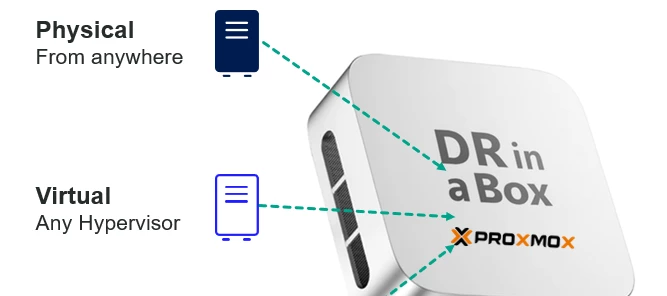
Introducing DR in a Box — Automated Windows Server Migration to ProxmoxIntroducing DR in a Box — Automated Windows Server Migration to ProxmoxDR in a Box is an automated, wizard-driven tool designed to simplify Windows Server migration and disaster recovery workflows by provisioning and failing over Physical, Virtual, or Cloud Windows Server workloads into Proxmox virtual machines. It leverages a web-based UI and a combination of JavaScript, APIs and PowerShell to discover sources, provision targets, synchronize data using the OpenText Migrate replication engine, and perform controlled failovers. Demo video can be found here How DR in a Box worksDR in a Box orchestrates the end-to-end migration and failover process using four coordinated stages:Discover — Agentless and agent-assisted discovery routines enumerate Windows Server sources (physical hosts, VMs, or cloud instances) and collect configuration and disk layout information. Provision — The wizard provisions Proxmox VM targets a
Hi, I’m an OpenText Solution Consultant specialising in OpenText Migrate and Availability. I’m currently writing an article covering the different methods of migrating servers from Broadcom VMware to Microsoft Hyper-V, and I’d be really interested in which methods you currently use?OpenText Migrate is able to migrate live Windows and Linux Machines with only a few minutes of downtime, but I know some customers who can tolerate hours of downtime will use alternative strategies:Microsoft Virtual Machine Converter - I believe it went End of Life in 2017 Microsoft Sysinternals VHDX2VHD - copy the VMDK and convert it to VHDx Third party tools than automate the VHDX2VHD tool with a GUI Backup from VMware and Restore to Hyper using existing backup and recovery toolsI’d be really interested to know what strategies you’re all using, and how reliable they are.
OpenText Core Endpoint Backup offers a REST API that provides access to key administrative functions within the Core Endpoint Backup vault dashboard. Using the API, you can manage companies, users, user groups, devices, and partners, as well as perform administrative tasks like restoring devices or setting legal holds.Before you can start making API calls, your account needs to be enabled for API access. This isn’t on by default—you’ll need to reach out to OpenText Support to have it activated.Once access is granted, you can authenticate and start working with the endpoints. Endpoints & Authentication: Each request requires a valid JSON Web Token (JWT) in the header. Supported Operations: The API allows you to create, update, list, and delete companies, users, and devices. You can also perform tasks such as suspending or replacing devices, managing user groups, sending passcodes, and initiating restores. Swagger Access: You can view the full API documentation directly from your
Nous sommes ravis d’annoncer le lancement de notre tout nouveau datacenter OpenText Core Cloud-to-Cloud Backup à Zurich, en Suisse. Onzième site à rejoindre notre réseau mondial, il reflète notre engagement continu à aider les organisations à répondre aux exigences en matière de résidence, de confidentialité et de performances des données dans les régions où elles opèrent.L’importance d’un datacenter suisseLa nLPD suisse, entrée en vigueur en septembre 2023, s’applique aux entreprises étrangères qui proposent leurs services aux résidents suisses. Elles sont tenues de désigner un représentant local comme PFPDT (préposé fédéral à la protection des données et à la transparence) et de signaler toute violation de sécurité dans un délai de 72 heures. Par exemple, un fournisseur de services gérés (MSP) allemand qui stocke les données Microsoft 365 d’un détaillant suisse en Allemagne peut encourir des frais de conformité pour respecter ces obligations. « Nous sommes ravis de ce nouveau datacen
Data is the life and blood of your business, but safeguarding that information is harder than ever before. New threats are constantly emerging, such as AI-powered threats, phishing attacks, denial of service attacks, and more. Then when you consider this next to traditional threats like server failures, natural disasters, and human error, there’s even more risk to your business-critical data. Recovering from these events can be a costly and time-consuming which is why more businesses are looking to implement robust disaster recovery plans.Developing and maintaining a comprehensive disaster recovery plan in-house requires significant investment in time and resources. Additionally, ensuring data integrity and seamless recovery of all your data can be complex. For disaster recovery plans to be successful, it is important to implement regular testing and updates to ensure your plan will work. Balancing these demands while maintaining your day-to-day IT operations can be a significant hurdl
Wir freuen uns, Ihnen den Start unseres neuesten OpenText Core Cloud-to-Cloud Backup-Rechenzentrums in Zürich bekanntgeben zu dürfen. Dies ist das elfte Zentrum in unserem globalen Netzwerk und unterstreicht unser fortwährendes Engagement, Unternehmen dabei zu unterstützen, Anforderungen an Datenspeicherung, Datenschutz und Leistung in den Regionen zu gewährleisten, in denen sie tätig sind. Darum sind Schweizer Rechenzentren so wichtigDie Schweizerische revDSG, die im September 2023 in Kraft getreten ist, gilt für ausländische Unternehmen, die sich an in der Schweiz ansässige Personen wenden, und macht die Benennung eines lokalen Vertreters in der Schweiz erforderlich, der als Anlaufstelle für den EDÖB und betroffene Personen dient, sowie die Meldung von Verstössen innerhalb von 72 Stunden erforderlich. Beispielsweise können einem deutschen MSP, der die Daten von Microsoft 365 eines Schweizer Händlers in Deutschland speichert, Konformitätskosten entstehen, um diese Verpflichtungen zu e
We are pleased to announce the launch of our newest OpenText Core Cloud-to-Cloud Backup data centre in Zurich, Switzerland. This is the eleventh facility in our global network and reflects our continued commitment to helping organizations address data residency, privacy, and performance requirements in their operating regions. Why a Swiss data centre matters Switzerland’s revFADP, effective September 2023, applies to foreign companies serving Swiss residents, requiring a local representative for the FDPIC and 72-hour breach reporting. For instance, a German MSP storing a Swiss retailer’s Microsoft 365 data in Germany may incur compliance costs to meet these obligations. “We are very pleased about the availability of the new Swiss DC for our OpenText Core Cloud-to-Cloud Backup Service. This gives our customers even more control over where they want to store their backups, including in our own Netcloud Cloud Service with data storage in Switzerland or in OpenText's AWS Swiss data centre
The Situation So, you work for a small retail company that pulls in about $15 million in annual sales. You’re the person in charge of the 10 servers running at HQ, which manages the 15 stores around the tri-state area. The stores are open 8am to 8pm weekdays, 9am until 7pm on Saturday and closed on Sunday. That means you have 70 hours of system up-time that is critical to your stores, but you also run a 24-hour on-line marketplace that contributes to the overall revenue. Like most businesses, you have deployed some level of recovery plans for individual applications, entire servers and the complete datacenter. You probably know your hourly downtime costs that includes indirect costs, like additional labor to get back online, lost data and reputation. Your recovery plan includes human, server, provider or even mother nature ‘error events’, and it includes a defined Recovery Time Objective (RTO) and Recovery Point Objective (RPO). Maybe you are paying a service company to provide ne
Whether you call it Lift and Shift, Rehost, Re-platform, Transform, or Refactor it essentially means you are looking to spend money now to save money later. The business events that drive the change may vary, but the needs are the same, to move off what you have and into something you want, or believe you need, to satisfy your business demands. The “want” and “need” essentially boils down to saving or making more money.I bet you feel that “the cloud” will address the money question because of the wonderful benefit of, <insert cloud marketing slogan here>. Hyperscale providers speak of elasticity, scalability, availability, reliability, optimized costs, improved performance, and innovative solutions. They will speak of the importance of Kubernetes, Containers, micro-services, statelessness, AI, ML, and highly secured options; however, hyperscale providers rarely, if ever, talk about something that is very important. Long-term strategies of portability and interoperability.This pap
Since 1987, I've used almost every available technology to transfer data across disparate infrastructures, including punch cards, platters, tape, floppy devices, portable block storage cartridges and USB devices. Each required some form of data encapsulation into a payload or packet to be sent to a destination, where it was received and presented to the I/O subsystem for processing. The challenge was always understanding the payload's contents, format, and destination. Different ways to replicate dataThe transmission of the data can be broken into three simple categories. File Level, Byte Level or Block Level replication. The simplest explanation of the differences is:File Level - Copies all its information at the application level using standard functions of the Operating System. Byte Level - Copies all changed information at the byte level through File System I/O defined to that Operating System Block Level – Copies changed disk blocks at the hardware level using Change Block Trac
Ever had one of those moments when you realized you should have paid the fee for the extended coverage? You know, for a small fee you can get a 3-year warrantee to fix or replace your purchase. You think, “I haven’t needed it before. It is just a waste of my money. I can get a Carmel swirly mocha-frap, half skim, decaf, boba and kale smoothie instead.” Well, skipping the fee maybe fine for your overnight web order of a Wi-Fi and Bluetooth mini Siri enabled key fob, but what about the “simple” IT project to move the 10 servers to the new location, or the transfer of 40 terabytes (TB) of data from the old storage array to the new one, or even the simple effort to move the development servers to “the cloud”… come-on… its development, how much risk can that be…Many providers preach the “cost of free” for the first 30 days, but you may also want to look at the cost of risk. Risk is a fickle thing… it is obvious that too few resources can incur risk by not having enough staff to complete th
When businesses hear that “end of support” is approaching for one of their core business systems, it often evokes fear – and a frantic scramble in the IT department to implement a quick fix. However, it doesn’t need to be this way! Windows SQL Server 2016 will reach the end of its extended support on July 14, 2026. While this date may seem like it is far away, now is the perfect time to assess your environments, plan your budget and allocate the resources needed to modernize these servers. Why modernize or migrate your SQL Server Modernizing and migrating SQL Server from an old, unsupported version is just one of the many reasons why a company might want to migrate its data. Many businesses choose to migrate their data with company mergers, hardware upgrades or moves to the cloud. But unfortunately, data migrations often entail downtime, data loss, operational disruption or compatibility issues. OpenText Migrate alleviates these concerns and simplifies the migration process. We p
Edward A. Murphy Jr., an aerospace engineer, coined the phrase: ‘Anything that can go wrong will go wrong’ back in the 1940s.I experienced Murphy’s Law firsthand during my time as a help desk manager working for an MSP in the late ’90s. One morning, I walked into the office to find an ashen-faced admin struggling to mount a corrupted hard drive. The failure had occurred the very same night he had forgotten to initiate a backup to a DAT tape—a small oversight with far-reaching and expensive repercussions.Fast forward to today, where approximately 60% of SMBs manage workloads and store data in the public cloud, trusting platforms like Google Workspace and Microsoft 365 to keep their data safe. Surely, these SaaS providers guarantee the protection of your data, right? Wrong.The Shared Responsibility Model means SaaS providers manage infrastructure, but customers are responsible for protecting their own data.The growing threat of SaaS data lossDespite the reliability of SaaS platforms, dat
Already have an account? Login
No account yet? Create an account
Enter your E-mail address. We'll send you an e-mail with instructions to reset your password.